2nd planet from the Sun
Venus
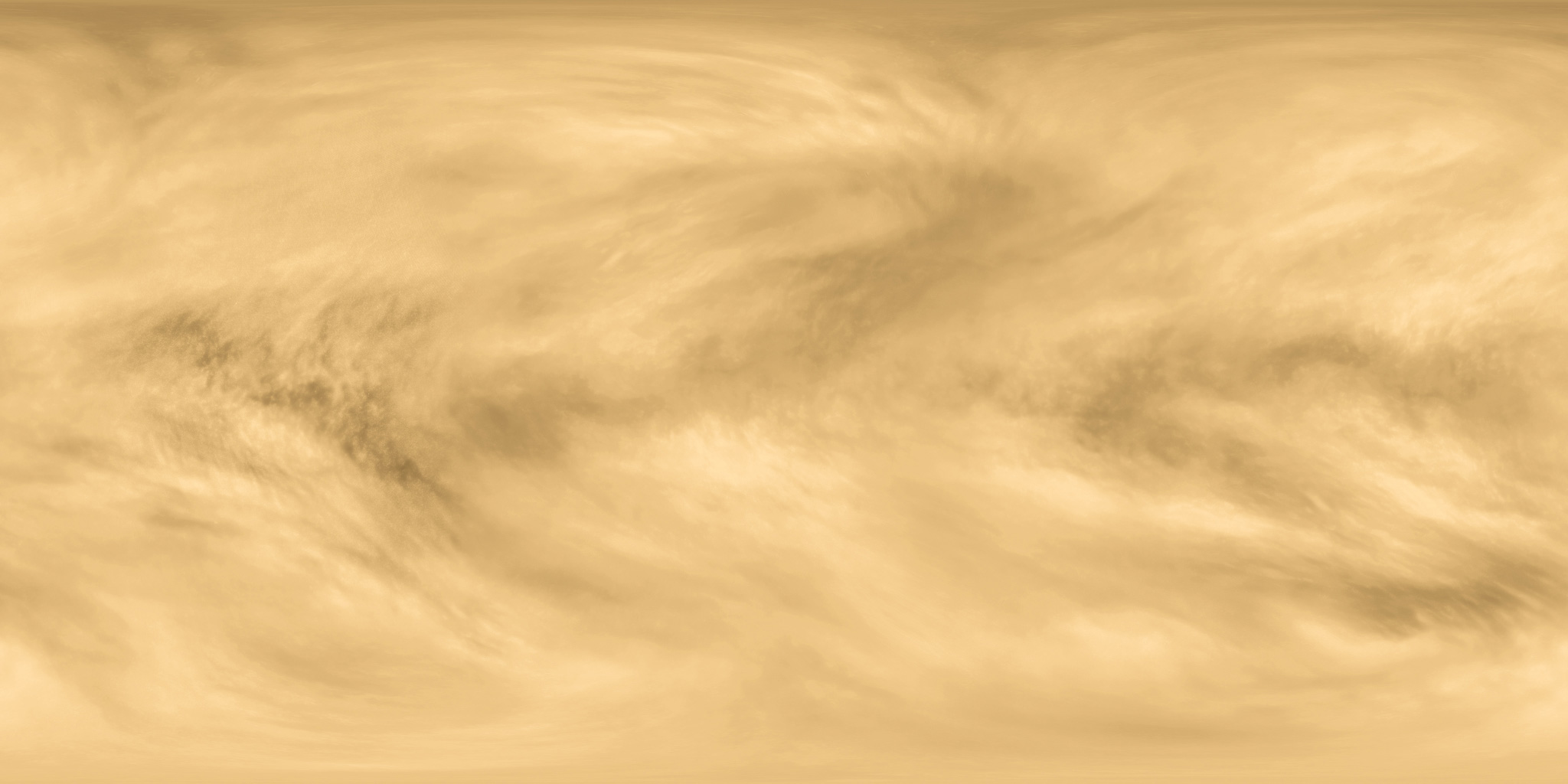
Almost Earth's twin in size, Venus is actually an infernal world: a runaway greenhouse effect keeps its surface at 465 °C, under a pressure 92 times that of Earth. And it spins backwards, so slowly that one day lasts longer than its year.
- Diameter
- 12,104 km
- Distance from Sun
- 108.2 M km
- Orbital period
- 225 days
- Rotation
- 243 days ↺
- Moons
- 0
- Temperature
- 465 °C
A runaway greenhouse effect
Venus's atmosphere is 96.5% carbon dioxide and so dense that surface pressure equals what you would find 900 metres deep in Earth's oceans. This blanket traps solar heat and spreads it everywhere: day or night, equator or poles, the temperature stays pinned around 465 °C.
At an altitude of 50-70 km the planet is wrapped in sulphuric acid clouds that reflect 75% of incoming sunlight: this is why Venus shines so brightly in our sky, the third most luminous object after the Sun and Moon. Beneath the clouds lie vast volcanic plains and thousands of volcanoes.
Spinning backwards
Venus is the only planet, along with Uranus, to rotate in a retrograde direction: seen from the celestial north pole it spins clockwise, opposite to all the others. Its rotation is also extremely slow — 243 Earth days, longer than its 225-day year — so on Venus the Sun rises in the west and sets in the east.
The origin of this oddity is debated: the leading hypotheses are a giant impact early in the planet's life, or a slow flipping of its axis driven by atmospheric tides and friction with the ultra-dense atmosphere.
Exploration
The Soviet Venera probes were the first to breach the Venusian inferno: in 1970 Venera 7 became the first craft to transmit from the surface of another planet, surviving 23 minutes before succumbing to heat and pressure. NASA's Magellan then mapped the entire surface by radar in the early 1990s.
Today Venus is back in the spotlight: NASA's VERITAS and DAVINCI missions and ESA's EnVision will study its geology and atmosphere in the coming years, to understand how a planet so similar to Earth ended up with such a different fate.
The moons of Venus
Venus has no natural satellites: its known moons number zero. No probe and no observing campaign has ever found one.
Frequently asked questions
Why is Venus so hot?
The cause is a runaway greenhouse effect: its CO₂ atmosphere, 92 times denser than ours, lets sunlight in but stops heat from escaping into space. The result is a constant 465 °C, enough to melt lead — hotter even than Mercury.
Why does Venus spin backwards?
We don't know for certain. The two leading hypotheses are: a gigantic impact that reversed its spin in the Solar System's early days, or a slow tipping of its axis caused by the Sun's gravitational tides acting on its ultra-dense atmosphere.
Can you see Venus with the naked eye?
Yes, and it's very easy: Venus is the brightest object in the sky after the Sun and Moon. It appears as a brilliant "star" shortly after sunset or before dawn — hence its nicknames, the Evening Star and the Morning Star.
Watch the whole Solar System in motion
Real orbits, moons and speeds rebuilt from NASA/JPL data, right in your browser. Free, nothing to install.
Launch the 3D simulation