Methane ice in the Kuiper Belt
Makemake
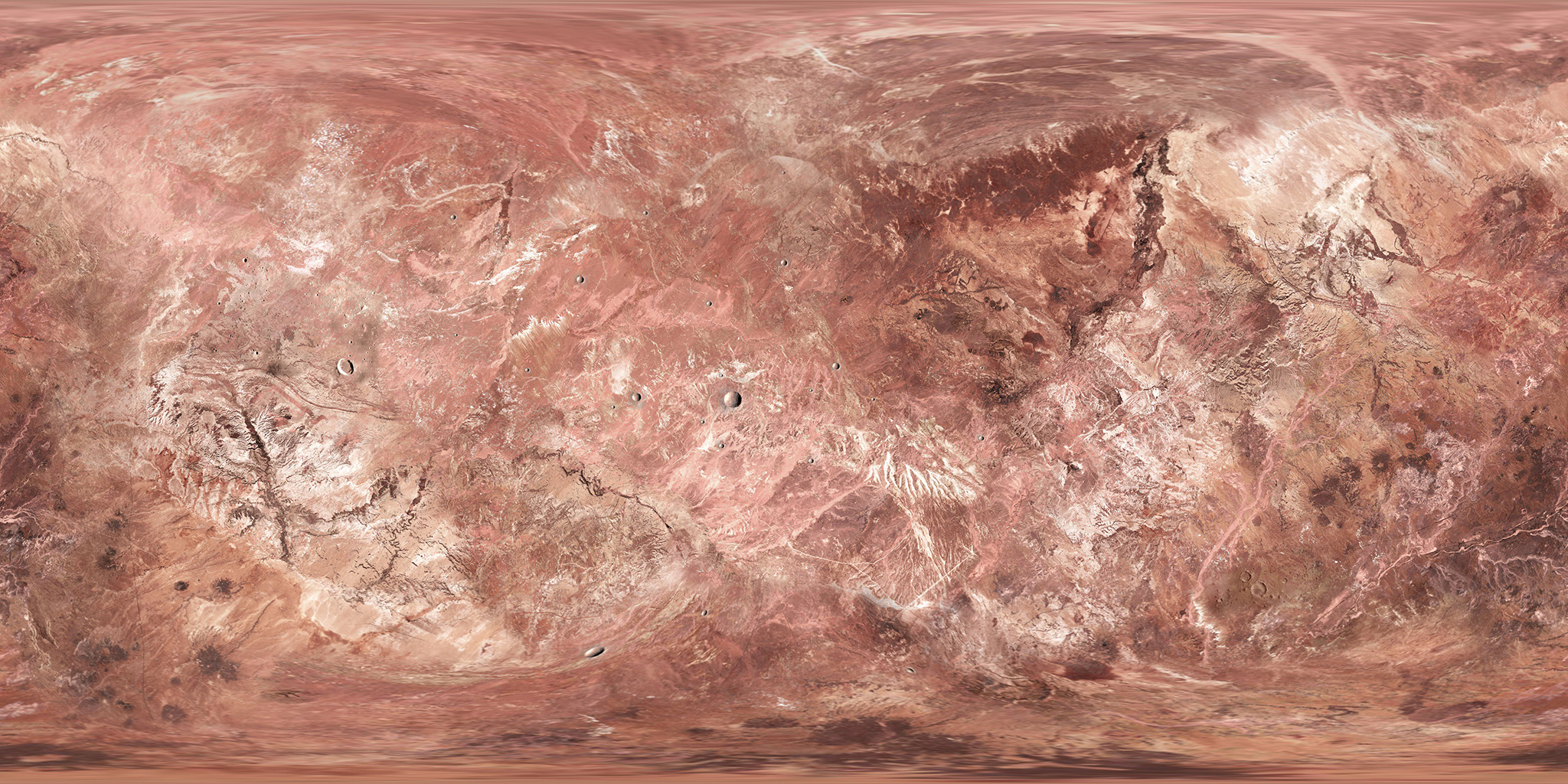
After Pluto it is the brightest object in the Kuiper Belt, and it was that brightness that made it detectable back in 2005. Its surface is covered in frozen methane and ethane which, exposed for billions of years to solar radiation, have turned into reddish organic compounds: from afar Makemake looks the colour of rust.
- Diameter
- 1,430 km
- Distance from Sun
- 6,806 M km
- Orbital period
- 307 years
- Day length
- 22.8 hours
- Moons
- 1
- Temperature
- -233 °C (approx.)
Physical characteristics
Makemake is about 1,430 km across, a little smaller than Pluto and a bit over two thirds of its estimated mass. The surface reflects about 80% of the light it receives, a very high figure explained by grains of frozen methane up to a centimetre wide — unusually coarse. Between the grains, tholins show through: the reddish organic compounds produced by solar radiation acting on methane.
A stellar occultation observed in 2011 ruled out a global atmosphere like Pluto's. It is possible, though, that as Makemake nears perihelion some of the methane sublimates into a temporary atmosphere, destined to fall back to the ground as snow when the body heads back towards aphelion.
Orbit and moon
Makemake orbits 6.8 billion km from the Sun with a period of 307 years, on an orbit inclined 29° and moderately eccentric. Like Haumea it belongs to the classical Kuiper Belt: far enough from Neptune not to be significantly perturbed by it. Its rotation lasts 22.8 hours, close to Earth's.
In 2016 the Hubble telescope spotted a small moon, provisionally named MK2: about 160 km across and extremely dark, reflecting barely 4% of the light, which explains why it had escaped notice for eleven years. Its orbit, still poorly determined, is the key to measuring Makemake's mass and density precisely.
Discovery and name
Michael Brown's team at Caltech spotted Makemake on 31 March 2005, a few weeks after Eris. Together, the two discoveries made the old definition of a planet untenable and led to the IAU resolution of 2006. Makemake was recognised as a dwarf planet the following year, in 2008.
The name comes from the creator of humanity in the mythology of the Rapa Nui, the people of Easter Island: it was chosen because the discovery fell shortly after Easter 2005. Before receiving its official name, the object was known within the team that found it by the nickname "Easterbunny".
The only moon of Makemake
Makemake has 1 confirmed natural satellite, discovered in 2015 and still unnamed: it carries the provisional designation S/2015 (136472) 1, nicknamed MK 2.
Frequently asked questions
How big is Makemake?
About 1,430 km across, a little smaller than Pluto (2,377 km) and roughly 40% of the Moon. It is the third largest dwarf planet after Eris and Pluto, and the second brightest object in the Kuiper Belt.
Why is Makemake red?
Because of tholins: organic compounds produced by solar radiation acting for billions of years on the frozen methane at the surface. The same process tints many Kuiper Belt bodies reddish-brown, including some regions of Pluto.
Does Makemake have moons?
Only one known, spotted by the Hubble telescope in 2016 and provisionally named MK2. It is about 160 km across and extremely dark: it reflects only 4% of the light, against Makemake's 80%, which is exactly why it stayed invisible for years.
Watch the whole Solar System in motion
Real orbits, moons and speeds rebuilt from NASA/JPL data, right in your browser. Free, nothing to install.
Launch the 3D simulation