1st planet from the Sun
Mercury
Small, rocky and surprisingly fast: Mercury completes a trip around the Sun in just 88 days, racing at 47 km per second. With no real atmosphere, its cratered surface swings from deep freeze to heat capable of melting lead.
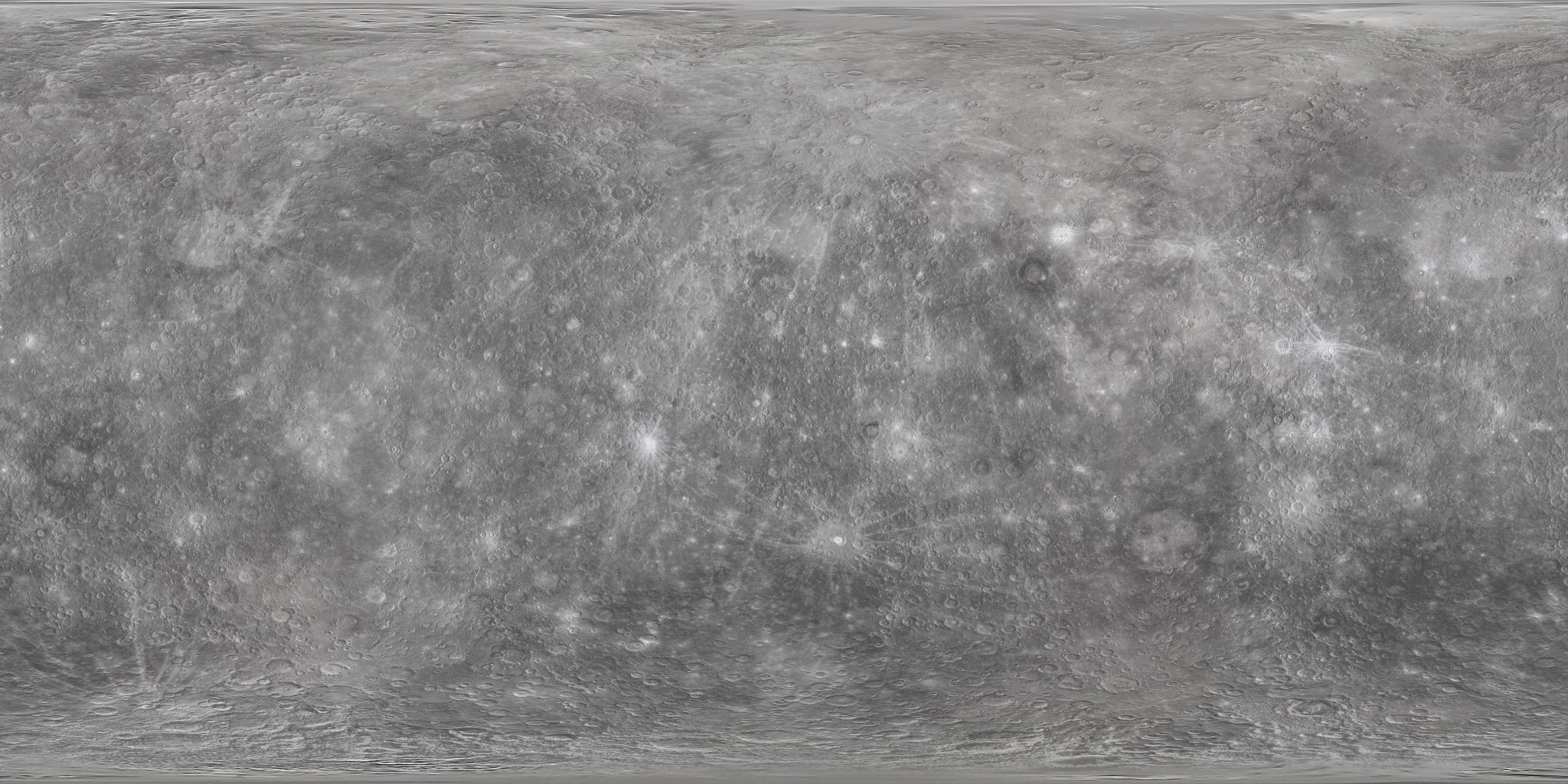
- Diameter
- 4,879 km
- Distance from Sun
- 57.9 M km
- Orbital period
- 88 days
- Day length
- 176 days
- Moons
- 0
- Temperature
- -180 / +430 °C
Physical characteristics
With a diameter of 4,879 km, Mercury is the smallest of the eight planets: barely larger than our Moon, and similar in appearance, with a grey surface pockmarked by billions of years of impacts. The Caloris basin, about 1,550 km across, is the scar of a colossal collision that happened in the Solar System's early days.
The real anomaly hides beneath the crust: an enormous iron core taking up about 85% of the planet's radius, a proportion unmatched in the Solar System. It is likely the remnant of a larger planet that lost most of its mantle in a giant impact.
Orbit and rotation
Mercury travels the most eccentric orbit of any planet: its distance from the Sun swings between 46 and 70 million km. Its spin is locked to its orbit in a 3:2 resonance — three rotations every two revolutions — so a full solar day lasts 176 Earth days, twice as long as its year.
With no atmosphere to redistribute heat, the day side bakes at up to +430 °C while the night side plunges to -180 °C: the largest temperature swing in the Solar System. In permanently shadowed polar craters, space probes have detected deposits of water ice.
Exploration
Observing Mercury up close is hard: its proximity to the Sun makes every mission a challenge of trajectories and temperatures. Mariner 10 photographed less than half of it in the 1970s; NASA's MESSENGER probe completed the first global map while orbiting the planet from 2011 to 2015.
The BepiColombo mission by ESA and JAXA, launched in 2018, is performing a long series of fly-bys to slow itself down and enter orbit around Mercury, where it will study the magnetic field, the surface and the mysterious giant core with two dedicated orbiters.
The moons of Mercury
Mercury has no natural satellites: its known moons number zero. No probe and no observing campaign has ever found one.
Frequently asked questions
Why isn't Mercury the hottest planet?
Although it is closest to the Sun, Mercury has no atmosphere capable of trapping heat: at night the temperature crashes to -180 °C. Venus, wrapped in a thick blanket of CO₂, holds a constant 465 °C and is the hottest planet in the Solar System.
How long is a day on Mercury?
A solar day on Mercury — from one sunrise to the next — lasts 176 Earth days, twice its 88-day year. The cause is the 3:2 resonance between spin and orbit: the planet rotates three times on its axis for every two trips around the Sun.
Does Mercury have moons?
No, Mercury has no moons, just like Venus. Its weak gravity and above all its closeness to the Sun make any satellite orbit unstable: the Sun's gravitational pull would eventually strip a moon away.
Watch the whole Solar System in motion
Real orbits, moons and speeds rebuilt from NASA/JPL data, right in your browser. Free, nothing to install.
Launch the 3D simulation