Dwarf planet in the asteroid belt
Ceres
Discovered in 1801 and taken first for a planet, then for an asteroid, Ceres is today a dwarf planet: the largest body in the main belt, accounting on its own for about a quarter of its mass. Beneath a dusty crust it hides as much frozen water as all the rivers of Earth hold.
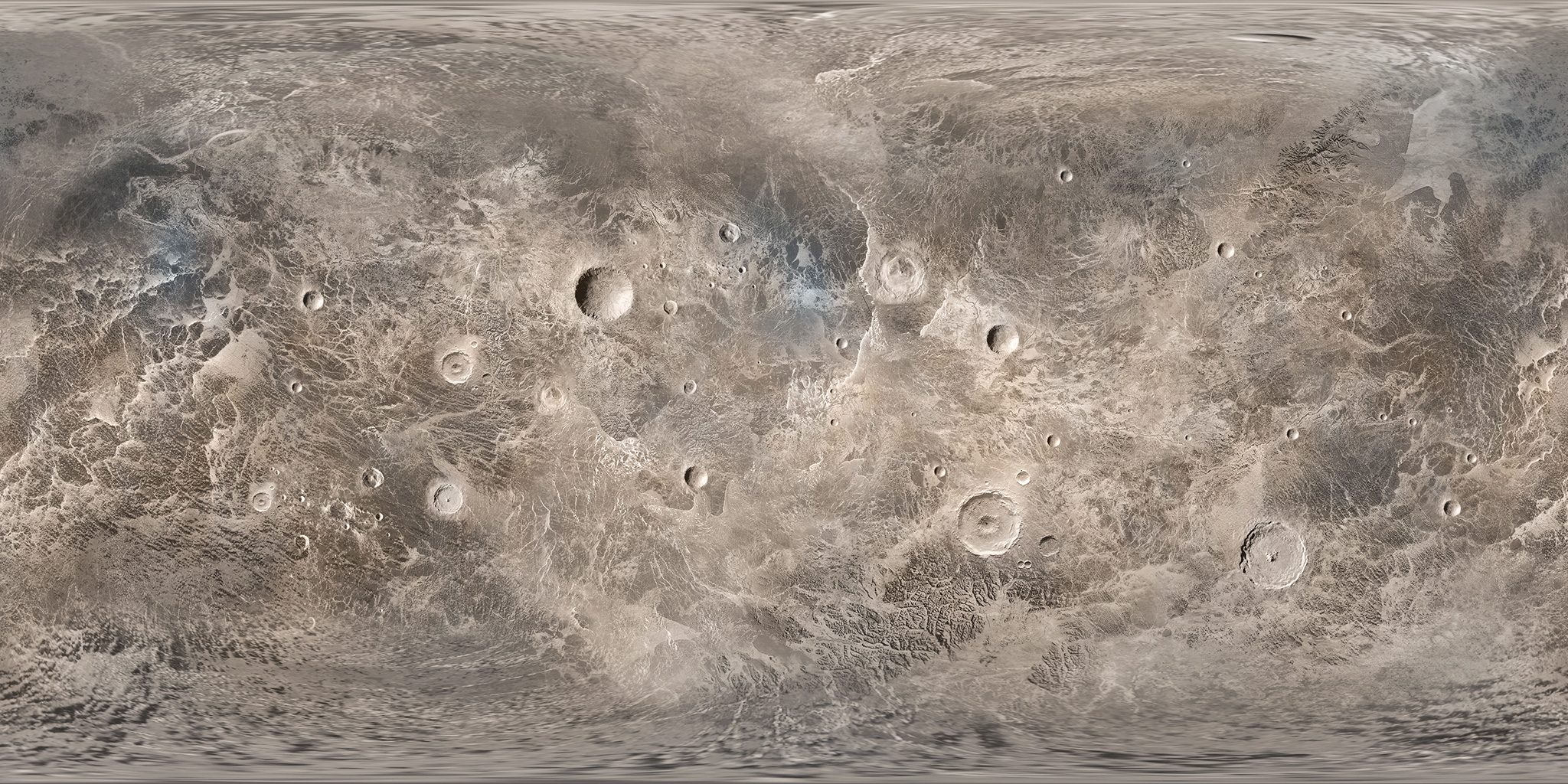
- Diameter
- 939 km
- Distance from Sun
- 414 M km
- Orbital period
- 4.6 years
- Day length
- 9 hours
- Moons
- 0
- Temperature
- -105 °C (mean)
Physical characteristics
At 939 km across, Ceres is massive enough to have pulled itself round under its own gravity — the requirement that sets it apart from the irregular asteroids around it — but not massive enough to have cleared its orbit, the criterion that stops it being called a planet. Surface gravity is a mere 0.28 m/s²: a jump that lifts you half a metre on Earth would carry you seventeen metres here.
The Dawn spacecraft, in orbit from 2015 to 2018, revealed a differentiated world: a rocky core, a mantle rich in water ice and a crust of clays and carbonates. The bright spots in Occator crater, visible even from a distance as two luminous patches, are deposits of sodium carbonate left by brines that welled up from below — evidence that liquid water exists, or existed recently, beneath the surface.
Orbit and rotation
Ceres orbits 414 million km from the Sun, right in the heart of the main belt between Mars and Jupiter, completing one lap in 4.6 years. Its orbit is moderately eccentric and inclined 10.6° to the ecliptic, enough to carry it appreciably above and below the plane of the planets over the course of a Cererian year.
Its spin is quick: a day lasts just 9 hours and 4 minutes, and the axis is tilted only 4°, so seasons on Ceres essentially do not exist. That minimal tilt has a striking consequence, though: some polar craters never receive sunlight and accumulate water ice, exactly as happens on Mercury.
Discovery and exploration
Giuseppe Piazzi spotted it from the Palermo Observatory on New Year's night of 1801, while looking for the planet that the Titius-Bode law predicted between Mars and Jupiter. It was regarded as a planet for half a century, until the discovery of dozens of other bodies in the same region led to its reclassification as an asteroid. In 2006, the same IAU resolution that demoted Pluto promoted Ceres to dwarf planet.
NASA's Dawn mission was the first to orbit two different bodies: first the asteroid Vesta, then Ceres, thanks to an ion engine. It mapped the entire surface, measured the composition and detected water vapour. The spacecraft, out of propellant since 2018, remains in orbit around Ceres: planetary protection rules forbid crashing it onto a world that might host liquid water.
The moons of Ceres
Ceres has no natural satellites: its known moons number zero. No probe and no observing campaign has ever found one.
Frequently asked questions
Is Ceres an asteroid or a dwarf planet?
Both, depending on the criterion. Ceres lies in the asteroid belt and is catalogued as asteroid number 1, but since 2006 the IAU also classifies it as a dwarf planet because its gravity has made it spherical. It is the only body in the inner Solar System to hold that title.
Is there water on Ceres?
Yes, in abundance. Water ice makes up a substantial fraction of the mantle, and the Dawn spacecraft detected water vapour escaping from the surface. The bright deposits in Occator crater are salts left by brines that welled up from below, suggesting liquid water at depth.
How big is Ceres compared with the Moon?
Ceres is 939 km across against the Moon's 3,475 km: about a quarter of our Moon in width and less than a hundredth of its mass. Even so, it remains by far the largest body in the asteroid belt.
Watch the whole Solar System in motion
Real orbits, moons and speeds rebuilt from NASA/JPL data, right in your browser. Free, nothing to install.
Launch the 3D simulation