The former ninth planet
Pluto
For seventy-six years it was the ninth planet; then the definition of "planet" changed and Pluto became the most famous of the dwarf planets. The demotion took nothing away from it: in 2015 the New Horizons probe revealed a geologically alive world, with mountains of water ice, nitrogen glaciers and a moon so large it makes the pair a double system.
- Diameter
- 2,377 km
- Distance from Sun
- 5,907 M km
- Orbital period
- 248 years
- Day length
- 6.4 days
- Moons
- 5
- Temperature
- -229 °C (mean)
Physical characteristics
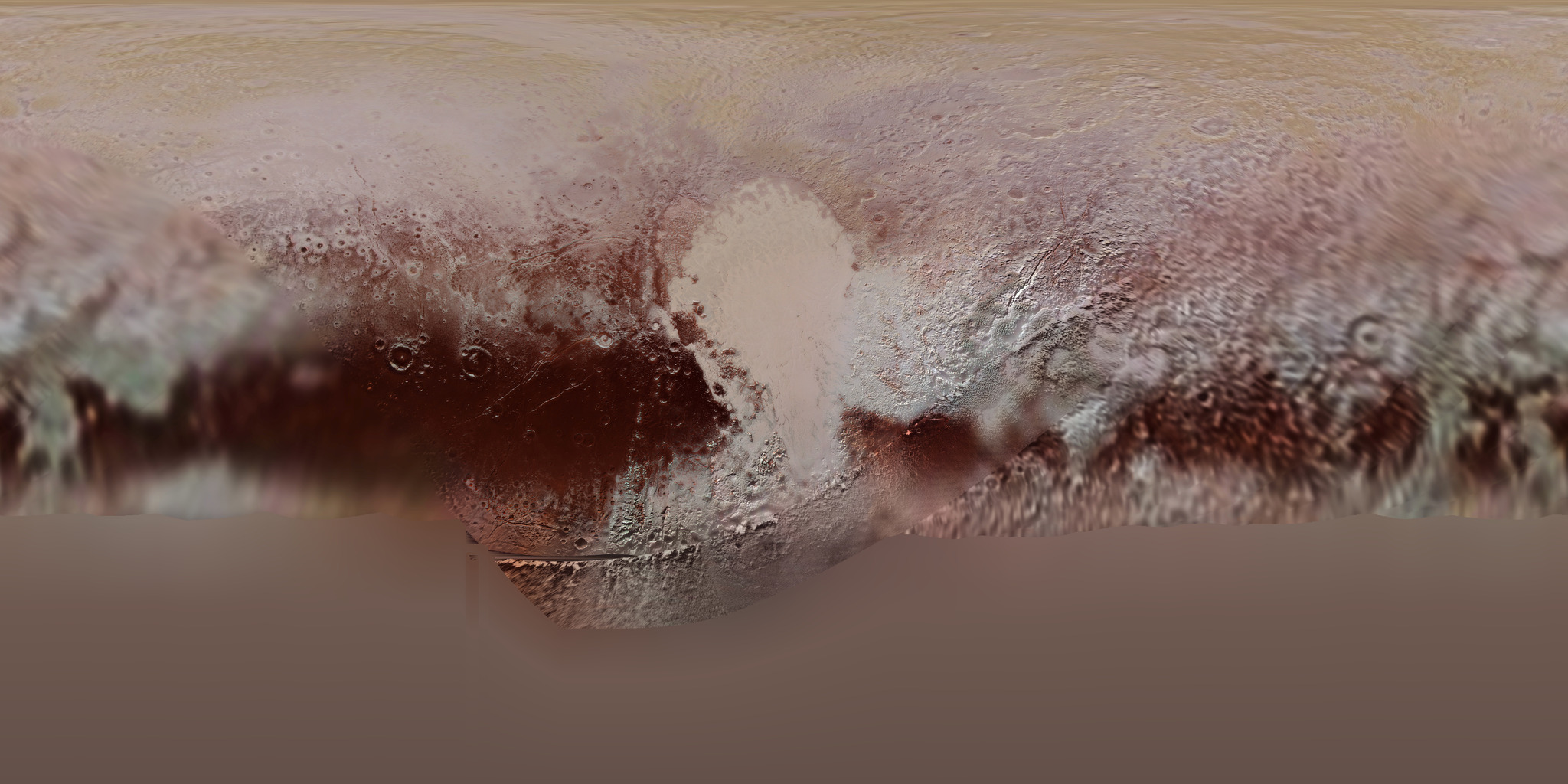
Pluto is 2,377 km across, less than a fifth of Earth's diameter and about two thirds of the Moon's. Its surface is a spread of nitrogen, methane and carbon monoxide ices over a rocky core; at those temperatures, around -229 °C, water ice is as hard as rock and forms genuine mountains, up to 3,500 metres tall.
Its most recognisable feature is Sputnik Planitia, the western half of the large bright heart-shaped region: a plain of frozen nitrogen roughly a thousand kilometres across, free of craters and therefore geologically very young. Its surface is divided into polygonal cells tens of kilometres wide, the signature of ongoing convection: the ice slowly overturns, like water boiling in extreme slow motion.
Orbit and double system
Pluto's orbit is the most unusual among the large known bodies: eccentric enough to swing it between 4.4 and 7.4 billion km from the Sun, and inclined 17° to the plane the planets move on. For twenty years out of every 248-year lap it sits closer to the Sun than Neptune — most recently between 1979 and 1999. The two are in no danger of colliding, though: a 3:2 resonance keeps them permanently apart, because Pluto completes exactly two orbits for every three of Neptune's.
Charon, the largest of the five moons, is half Pluto's diameter and a twelfth of its mass: enough for the system's barycentre to fall outside Pluto's surface, about 2,100 km from its centre. The two therefore behave not like a planet and its satellite but like a pair circling an empty point in space, permanently showing each other the same face. The other four moons — Styx, Nix, Kerberos and Hydra — are irregular bodies just tens of kilometres across.
Why it is no longer a planet
Clyde Tombaugh discovered Pluto in 1930 and for decades it counted as the ninth planet. Trouble began in the 1990s, when the Kuiper Belt turned out to be populated by thousands of icy bodies much like it. The decisive blow came in 2005 with Eris, more massive than Pluto: either dozens of new planets had to be accepted, or the definition had to change.
In 2006 the IAU laid down three requirements: orbiting the Sun, having enough mass to assume a spherical shape, and having cleared its orbit of other bodies. Pluto meets the first two but not the third, because it shares its belt with countless trans-Neptunian objects. Hence the new dwarf planet category, which today has five official members.
The 5 moons of Pluto
Pluto has 5 confirmed natural satellites, every one of them officially named by the International Astronomical Union.
- Charon
- Styx
- Nix
- Kerberos
- Hydra
Frequently asked questions
Why is Pluto no longer a planet?
Because it fails the third of the three criteria the IAU set in 2006: it has not cleared its orbit of other bodies. Pluto shares the Kuiper Belt with thousands of icy objects of comparable size, whereas a planet is gravitationally dominant in the region it travels through.
How many moons does Pluto have?
Five: Charon, by far the largest, then Styx, Nix, Kerberos and Hydra, all discovered between 2005 and 2012 by the Hubble telescope. Charon is so massive relative to Pluto that the two effectively form a double system.
Is Pluto ever closer to the Sun than Neptune?
Sometimes, yes. Its orbit is so eccentric that for about twenty years out of every 248-year lap it sits inside Neptune's orbit: this last happened from 1979 to 1999. A 3:2 resonance between the two nonetheless rules out any dangerous approach.
Watch the whole Solar System in motion
Real orbits, moons and speeds rebuilt from NASA/JPL data, right in your browser. Free, nothing to install.
Launch the 3D simulation