5th planet from the Sun
Jupiter
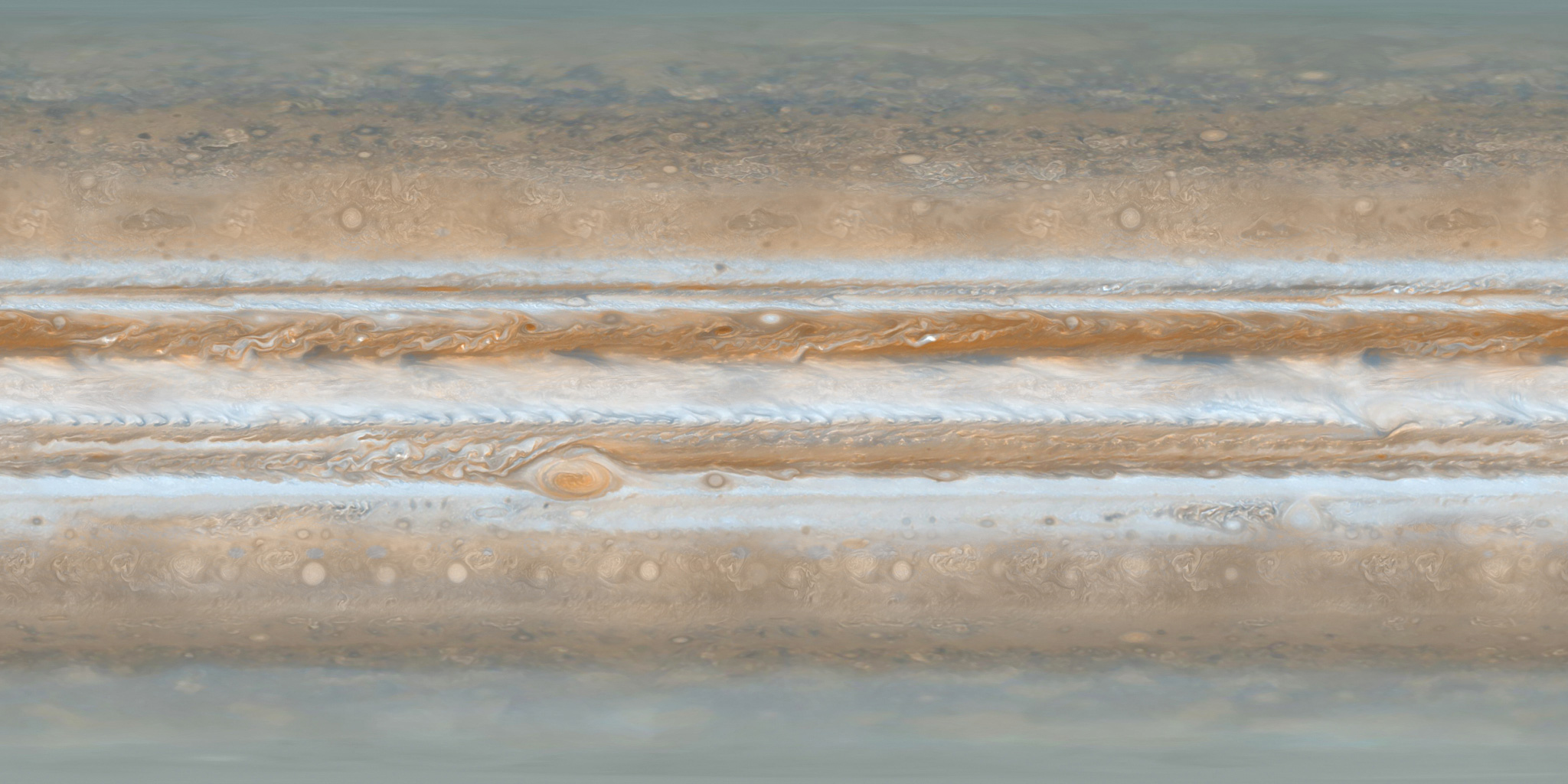
Jupiter is the giant that dominates the Solar System: on its own it outweighs all the other planets combined, twice over. Beneath its colourful bands rage storms the size of Earth, while a retinue of 115 moons orbits around it — a miniature solar system.
- Diameter
- 142,984 km
- Distance from Sun
- 778.5 M km
- Orbital period
- 11.86 years
- Day length
- 9h 56m
- Moons
- 115
- Average temp.
- -108 °C
The king of planets
With a diameter of 142,984 km — 11 times Earth's — Jupiter is by far the largest planet in the Solar System: more than 1,300 Earths would fit inside its volume. It is made almost entirely of hydrogen and helium, like a star, but lacks the mass needed to ignite nuclear fusion.
Despite its bulk, Jupiter is the fastest-spinning planet: a day lasts just 9 hours and 56 minutes. This dizzying rotation flattens the planet at its poles, stretches its clouds into bands parallel to the equator and powers a magnetic field 20,000 times stronger than Earth's.
The Great Red Spot
Jupiter's signature feature is an anticyclone larger than Earth that has raged for at least 350 years: the Great Red Spot. Its winds exceed 400 km/h, and its characteristic red colour — whose chemical origin is still debated — makes it the most recognisable detail in the Solar System.
Recent observations show the storm is slowly shrinking: a century ago it was three times as wide as Earth, today "only" one and a half times. Whether it will dissolve or stabilise is unknown — one of planetary meteorology's great open mysteries.
The Galilean moons
In 1610 Galileo pointed his telescope at Jupiter and discovered four "stars" dancing around it: Io, Europa, Ganymede and Callisto. It was the first proof that not everything orbits the Earth. Ganymede, at 5,268 km across, is the largest moon in the Solar System — bigger even than Mercury.
Each Galilean moon is a world of its own: Io is the most volcanic body in the Solar System, kneaded by Jupiter's tides; Europa hides a liquid-water ocean beneath its icy crust that could harbour life — the target of NASA's Europa Clipper and ESA's JUICE missions, both currently en route.
The 115 moons of Jupiter
Jupiter has 115 confirmed natural satellites (IAU / Minor Planet Center figures as of June 2026). Of those, 57 have received an official name; the other 58 so far carry only a provisional designation, such as S/2003 J 2.
Inner satellites 4
- Metis
- Adrastea
- Amalthea
- Thebe
Galilean moons 4
- Io
- Europa
- Ganymede
- Callisto
Himalia group 7
- Leda
- Himalia
- Ersa
- Pandia
- Elara
- Lysithea
- Dia
Ananke group 13
- Euporie
- Eupheme
- Thelxinoe
- Euanthe
- Helike
- Orthosie
- Iocaste
- Praxidike
- Harpalyke
- Mneme
- Hermippe
- Thyone
- Ananke
Carme group 14
- Herse
- Aitne
- Kale
- Taygete
- Chaldene
- Erinome
- Kallichore
- Kalyke
- Carme
- Pasithee
- Eukelade
- Arche
- Isonoe
- Eirene
Pasiphae group 12
- Philophrosyne
- Aoede
- Callirrhoe
- Eurydome
- Cyllene
- Pasiphae
- Hegemone
- Sinope
- Sponde
- Autonoe
- Kore
- Megaclite
Unaffiliated irregulars 3
- Themisto
- Carpo
- Valetudo
Frequently asked questions
How many moons does Jupiter have?
As of 2026 Jupiter has 115 known moons, following the latest Minor Planet Center confirmations. The four largest — Io, Europa, Ganymede and Callisto — were discovered by Galileo in 1610; nearly all the others are irregular bodies a few kilometres across, captured by the giant's gravity.
What is the Great Red Spot?
It is a gigantic anticyclone — a high-pressure storm — active for at least 350 years, with winds above 400 km/h. It is vast enough to swallow the whole Earth, although observations show it is slowly shrinking.
Is Jupiter a failed star?
In a sense: it is made of the same ingredients as the Sun, hydrogen and helium, but it would need about 80 times its current mass to ignite nuclear fusion. Even so, Jupiter radiates more heat than it receives from the Sun, a leftover of its gravitational contraction.
Watch the whole Solar System in motion
Real orbits, moons and speeds rebuilt from NASA/JPL data, right in your browser. Free, nothing to install.
Launch the 3D simulation