The fastest-spinning dwarf planet
Haumea
Haumea is the fastest-rotating body in the entire Solar System: one turn every 3.9 hours. Centrifugal force has stretched it into an elongated ellipsoid, more than twice as wide as it is tall. In 2017 a stellar occultation revealed that it also has a ring: the first ever observed around an object beyond Neptune.
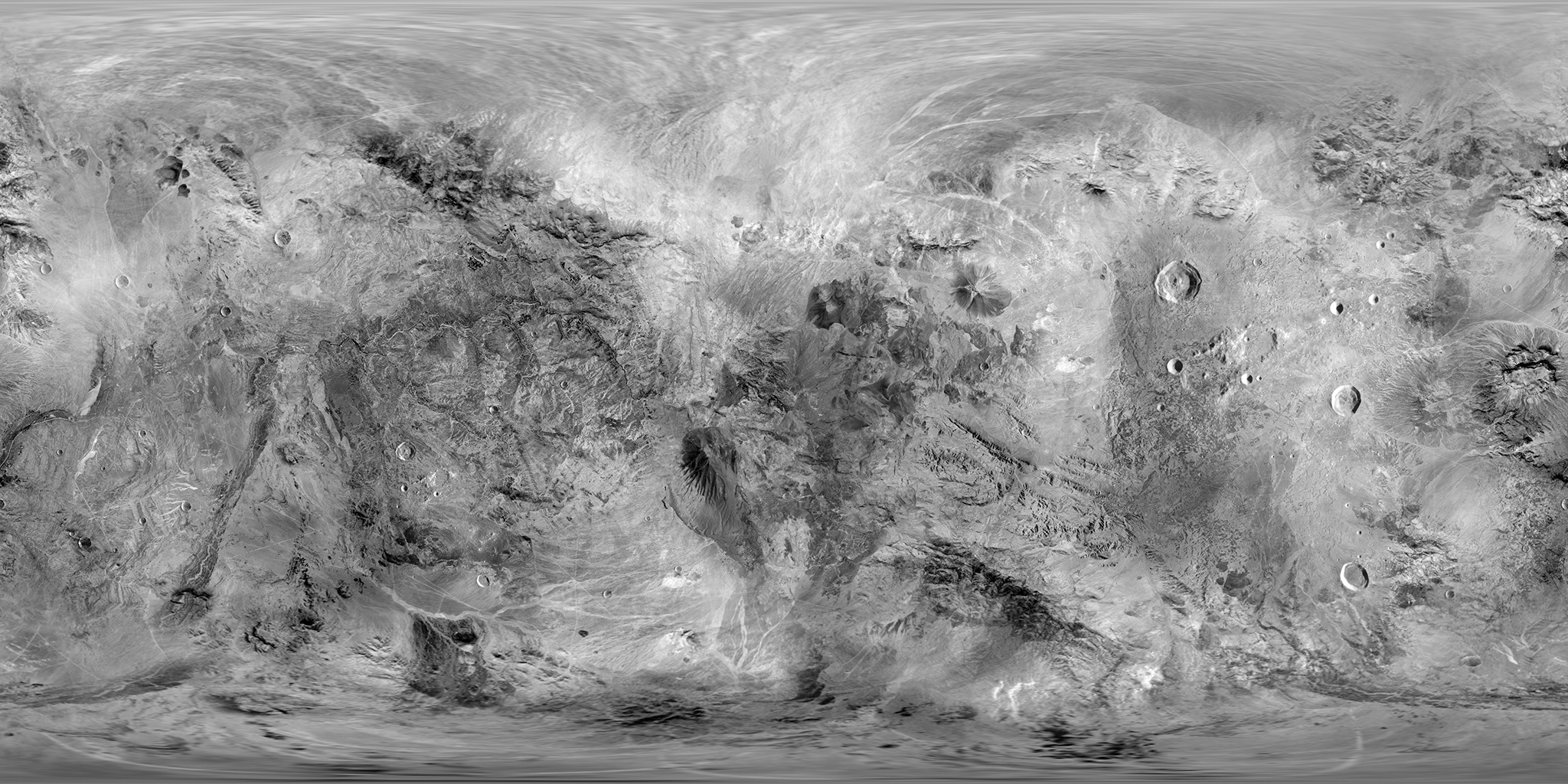
- Dimensions
- 2,322 × 1,704 × 1,026 km
- Distance from Sun
- 6,448 M km
- Orbital period
- 283 years
- Day length
- 3.9 hours
- Moons
- 2
- Temperature
- -241 °C (approx.)
Shape and composition
No other body of this size spins so fast. One rotation every 3 hours and 55 minutes generates enough centrifugal force to flatten Haumea along its polar axis and stretch it along the equator: the 2017 stellar occultations measured axes of 2,322, 1,704 and 1,026 km. Scaled down to the size of a ball, it would look like a rugby ball.
The surface is coated in crystalline water ice, unusually pure and bright, while the overall density points to a mostly rocky interior. The dizzying spin, the two moons and a dozen other icy bodies sharing the same orbit and composition are all thought to stem from a single, very ancient impact: the only known collisional family in the Kuiper Belt.
The ring and the moons
On 21 January 2017 Haumea passed in front of a distant star and several telescopes recorded its shadow. The data showed an unexpected dip in light before and after the main body: a ring 70 km wide, 2,287 km from the centre. It sits there for a precise reason, a 3:1 resonance — the ring particles complete one lap for every three rotations of Haumea.
The two moons, Hi'iaka and Namaka, are named after Haumea's daughters in Hawaiian mythology. Hi'iaka, the larger, is about 320 km across and is likewise coated in pure water ice, a further hint of a common collisional origin. Their orbits made it possible to measure Haumea's mass precisely.
Orbit and discovery
Haumea follows an orbit 6.4 billion km from the Sun, inclined 28°, with a period of 283 years. It is a classical Kuiper Belt object, far enough from Neptune not to be dominated by it. At its current distance, sunlight takes about six hours to reach it.
Its discovery, in 2004-2005, was at the centre of a dispute between José Luis Ortiz's Spanish team and Michael Brown's Californian one. The IAU credited the Spanish report but assigned the name proposed by the Americans. Haumea is the Hawaiian goddess of fertility and childbirth — a nod to the family of fragments the body left behind.
The 2 moons of Haumea
Haumea has 2 confirmed natural satellites, every one of them officially named by the International Astronomical Union.
- Hiʻiaka
- Namaka
Frequently asked questions
Why is Haumea elongated?
Because of its rotation. It turns on its axis in just 3.9 hours, and the resulting centrifugal force partly overcomes gravity: the body stretches at the equator and flattens at the poles, taking the shape of a triaxial ellipsoid. It is the fastest rotation of any large body in the Solar System.
Does Haumea really have a ring?
Yes. It was discovered on 21 January 2017 by observing a stellar occultation: the ring, 70 km wide and 2,287 km from the centre, produced a dip in brightness before and after the body passed. It was the first ring ever detected around a trans-Neptunian object.
How long is a day on Haumea?
Three hours and 55 minutes. It is the shortest day in the entire Solar System among bodies of significant size: in the time it takes to work a morning on Earth, the Sun rises and sets twice on Haumea.
Watch the whole Solar System in motion
Real orbits, moons and speeds rebuilt from NASA/JPL data, right in your browser. Free, nothing to install.
Launch the 3D simulation