The most massive dwarf planet
Eris
It was the discovery of Eris, in 2005, that forced astronomers to define for the first time what a planet actually is — and so to demote Pluto. Marginally smaller than Pluto but 27% more massive, it follows an extreme orbit: inclined 44° to the plane of the Solar System and stretched enough to carry it 14.6 billion km from the Sun.
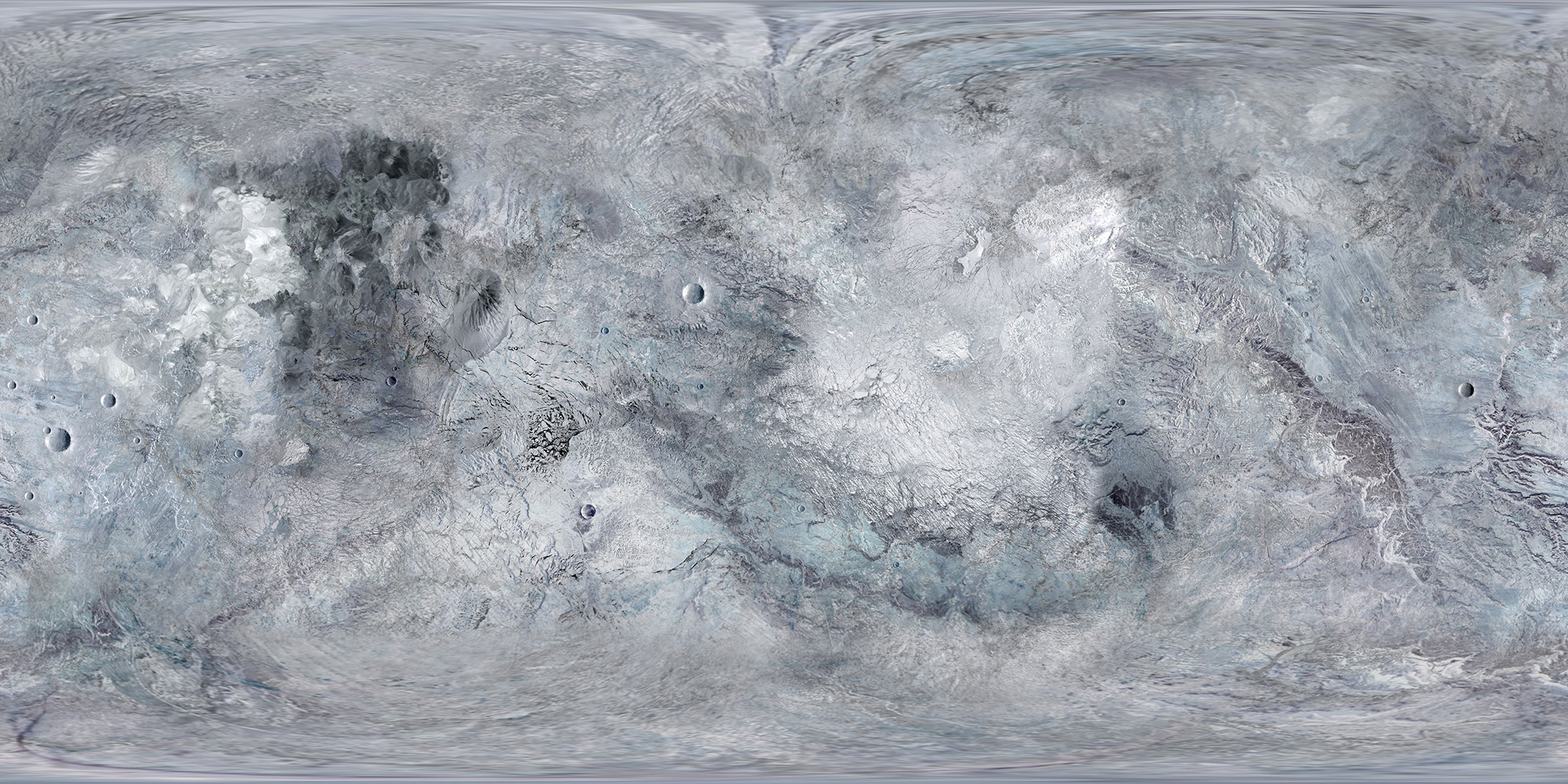
- Diameter
- 2,326 km
- Distance from Sun
- 10,147 M km
- Orbital period
- 558 years
- Day length
- 15.8 days
- Moons
- 1
- Temperature
- -243 °C (approx.)
Physical characteristics
Eris is 2,326 km across, barely fifty less than Pluto, yet 27% more massive: its higher density points to a far rockier interior, with ice confined to a surface shell. It is the most massive body in the Solar System that is neither a planet nor a moon of one.
Its surface reflects 96% of the light it receives: nearly white, among the most reflective in the Solar System, comparable to fresh snow. The favoured explanation is that at aphelion its nitrogen and methane atmosphere freezes out completely and falls to the ground, coating the whole body in fresh frost; as it draws closer to the Sun, some of that frost would sublimate again.
An extreme orbit
Eris's orbit is the most eccentric among the recognised dwarf planets: its distance from the Sun runs from 5.7 billion km at perihelion to 14.6 billion at aphelion, and one full lap takes 558 years. Its 44° inclination carries it well out of the plane the planets move on, so much so that Eris is regarded as a scattered disc object, flung out there by Neptune's gravitational influence.
Its only moon, Dysnomia, is about 615 km across and completes one lap in 15.8 days. In 2023 it emerged that this is also Eris's rotation period: the dwarf planet is tidally locked to its own moon, and the two permanently show each other the same face. A day on Eris therefore lasts more than two Earth weeks.
The discovery that changed the rules
The team of Michael Brown, Chad Trujillo and David Rabinowitz spotted Eris in images from 2003, recognising it in January 2005. Early estimates made it larger than Pluto, and for a short while it was presented as the tenth planet. The dilemma was stark: either Eris became a planet, and with it dozens of other bodies waiting in line, or a formal definition was needed.
The IAU took the second route in August 2006, creating the dwarf planet category. The chosen name was no accident: Eris is the Greek goddess of discord, and the moon carries the name of her daughter Dysnomia, lawlessness. A wry nod both to the scientific dispute and to Lucy Lawless, the actress who played Xena — the informal nickname the body carried before its official christening.
The only moon of Eris
Eris has one confirmed natural satellite, officially named by the International Astronomical Union.
- Dysnomia
Frequently asked questions
Is Eris bigger than Pluto?
In mass yes, in diameter no. Eris is 27% more massive than Pluto, but occultation measurements established that its diameter (2,326 km) is slightly smaller than Pluto's (2,377 km). The mass difference at comparable size points to a far rockier interior.
Why did the discovery of Eris demote Pluto?
Because it made the old definition untenable. If Pluto was a planet, so was Eris, which is more massive — and with them dozens of other Kuiper Belt bodies already found or waiting. In 2006 the IAU chose instead to set three formal criteria, and the one about "clearing the orbit" excluded both.
How far away is Eris?
The semi-major axis of its orbit is 10.1 billion km, about 68 times the Earth-Sun distance, but its eccentricity swings that between 5.7 and 14.6 billion. At aphelion, sunlight takes more than thirteen hours to reach it.
Watch the whole Solar System in motion
Real orbits, moons and speeds rebuilt from NASA/JPL data, right in your browser. Free, nothing to install.
Launch the 3D simulation