The star at the heart of the Solar System
The Sun
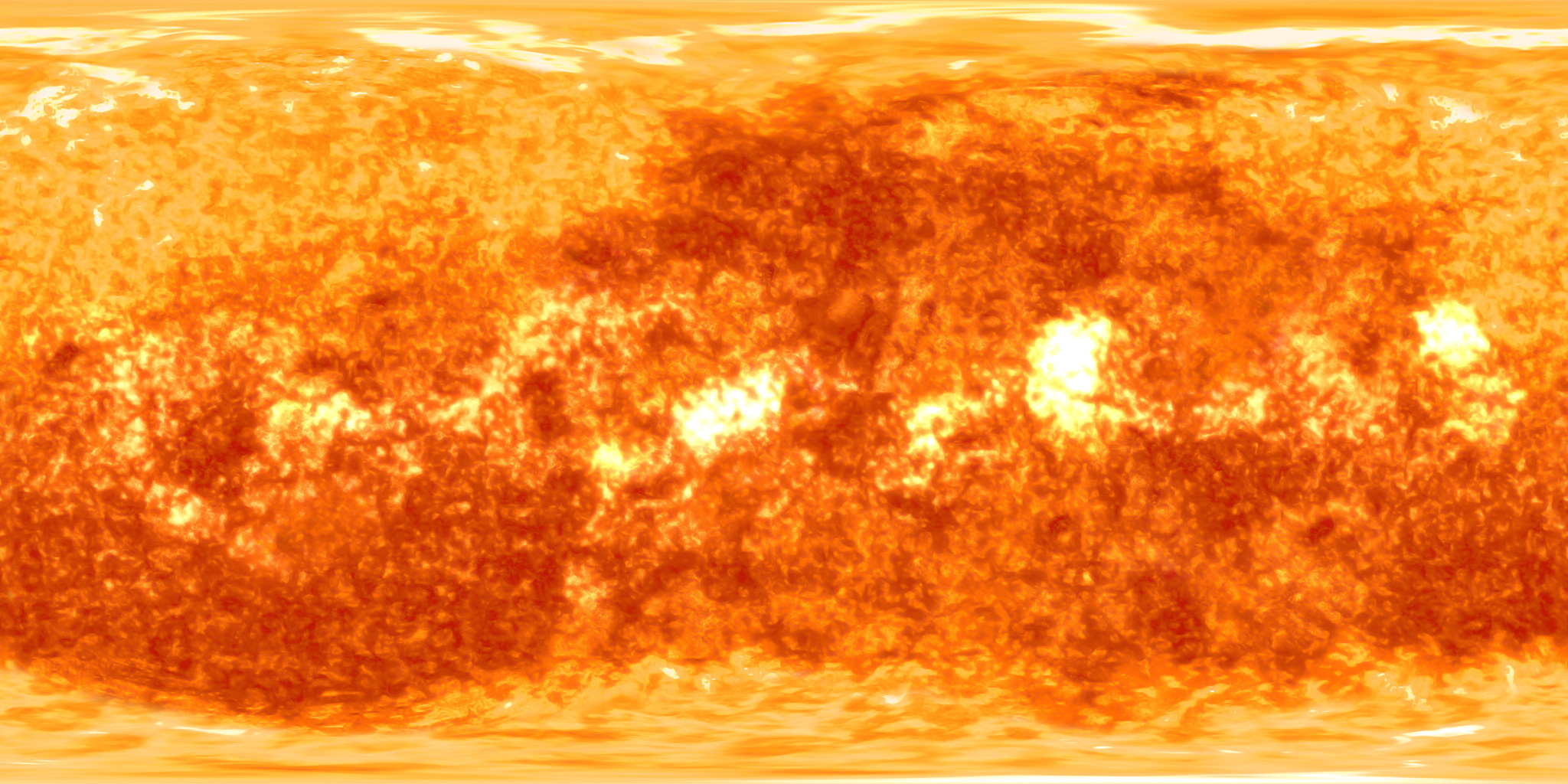
A star like billions of others, yet the only one we depend on: the Sun is a sphere of plasma 109 times wider than Earth that has been turning hydrogen into helium in its core for 4.6 billion years. Its gravity holds planets, moons and comets together; its light, which left it eight minutes ago, makes life possible.
- Diameter
- 1.39 M km
- Distance from Earth
- 149.6 M km
- Mass
- 333,000 Earths
- Rotation
- 25–35 days
- Age
- 4.6 bn years
- Surface temperature
- 5,500 °C
A middle-aged yellow dwarf
The Sun is a G2V star, a 'yellow dwarf' halfway through its life: it formed 4.6 billion years ago from the collapse of a cloud of gas and dust, the same cloud that gave birth to the planets. At 1.39 million km across it is 109 times wider than Earth and could hold about 1.3 million Earths. Compared with the other stars of the Milky Way, most of them small red dwarfs, it is larger and brighter than average.
On its own it holds 99.86% of the entire Solar System's mass: it weighs as much as 333,000 Earths, and its surface gravity is 28 times Earth's. It has no solid surface: it is a sphere of plasma made of roughly three quarters hydrogen and one quarter helium, with just under 2% of heavier elements such as oxygen, carbon, neon and iron. Precisely because it is fluid, it spins faster at the equator, in 25 days, than at the poles, where it takes about 35.
From core to corona
In the core, where the temperature reaches 15 million °C and the density is 150 times that of water, nuclear fusion turns about 600 million tonnes of hydrogen into helium every second. In the process about 4 million tonnes of matter become pure energy: the source of the light and heat we receive. That energy takes up to 170,000 years to cross the radiative zone, absorbed and re-emitted over and over, before it reaches the outer layers.
In the convective zone the plasma boils like water in a pan and carries heat up to the photosphere, the visible 'surface', at about 5,500 °C and speckled with granules around a thousand km wide. Above it lie the chromosphere and the corona, the outer atmosphere that can be seen with the naked eye only during total eclipses. Here the unexpected happens: the corona exceeds a million degrees, more than a hundred times the temperature of the surface below, and explaining why is one of the great open problems of solar physics.
Sunspots, flares and the 11-year cycle
The Sun is a magnetic, restless star. Its magnetic field, twisted by the faster spin at the equator, breaks through the surface and creates sunspots: regions more than a thousand degrees cooler, which look dark by contrast. When field lines reconnect they release enormous energy within minutes, as flares and coronal mass ejections, clouds of plasma hurled into space sometimes at more than a thousand km per second. Meanwhile the solar wind blows continuously from the corona, filling the heliosphere: the bubble that surrounds all the planets.
The number of sunspots rises and falls over a cycle of about 11 years, at the end of which the magnetic poles flip. Solar Cycle 25, which began in December 2019, peaked between 2024 and 2025, stronger than forecast: in May 2024 the most powerful geomagnetic storm in over twenty years lit up auroras seen as far south as Italy. In 2026 activity is in its declining phase, but this is exactly when some of the most powerful eruptions can still occur.
Missions to the Sun
The Sun has been watched non-stop for decades: the ESA/NASA SOHO spacecraft has been monitoring it since 1995, discovering more than 5,000 comets along the way, while NASA's Solar Dynamics Observatory has been imaging its disc in high resolution since 2010. On 24 December 2024 Parker Solar Probe passed just 6.1 million km from the surface, racing through the corona at 692,000 km/h: the highest speed ever reached by a human-made object. Throughout 2025 it repeated that record-breaking pass several times.
The European Solar Orbiter spacecraft, which also carries the Italian-led Metis coronagraph, tilted its orbit to 17° in 2025 and photographed one of the Sun's poles, the south pole, for the first time: a key region for understanding how the magnetic field flips every cycle. Also in 2025, ESA's Proba-3 mission created the first artificial eclipses in orbit, with two satellites flying in formation 150 metres apart. On the ground, in Hawaii, the Inouye telescope with its 4-metre mirror is the largest solar telescope in the world.
The Sun's future
The Sun is slowly growing brighter, by about 10% every billion years: in a billion years its heat will be enough to boil away Earth's oceans. In about 5 billion years, once the hydrogen in its core runs out, it will swell into a red giant hundreds of times larger than today, swallowing Mercury, Venus and perhaps Earth as well.
It will not explode as a supernova: that would take a star at least eight times more massive. After scattering its outer layers into a planetary nebula, all that will remain of the Sun is its core, a white dwarf roughly the size of Earth but extremely dense, set to cool slowly for billions of years.
The bodies orbiting the Sun
Orbiting the Sun are 8 planets and 5 IAU-recognised dwarf planets, along with hundreds of moons, more than a million known asteroids and countless comets. Pick a body to open its profile.
Frequently asked questions
How hot is the Sun?
It depends on the layer: the photosphere, the visible surface, is at about 5,500 °C, while the core reaches 15 million °C. The corona, the outermost atmosphere, exceeds a million degrees despite being further from the core: a paradox that Parker Solar Probe and Solar Orbiter are trying to solve.
How long does sunlight take to reach Earth?
On average about 8 minutes and 20 seconds to cover 149.6 million km: the Sun we see is the Sun of eight minutes ago. The time changes by a few seconds over the year, from about 8 min 10 s at January's perihelion to 8 min 27 s at July's aphelion. The energy in that light, however, was born in the core up to 170,000 years earlier.
What colour is the Sun really?
White. The Sun emits light of every colour, which adds up to white: that is how astronauts see it from space. It looks yellow to us, and orange or red at sunrise and sunset, because Earth's atmosphere scatters mostly blue light, the same light that colours the sky. The name 'yellow dwarf' comes from its spectral classification, not from how it really looks.
When will the Sun die?
Not for about 5 billion years. Once the hydrogen in its core runs out, the Sun will expand into a red giant, then shed its outer layers and shrink into a white dwarf that will slowly cool. It will never become a supernova: it is not massive enough.
When is the next total solar eclipse?
On 2 August 2027. The path of totality will cross southern Spain, the Strait of Gibraltar and North Africa, and near Luxor in Egypt totality will last 6 minutes 23 seconds: the longest seen from land until 2114. The previous one, on 12 August 2026, was visible from Greenland, Iceland and Spain.
Watch the whole Solar System in motion
Real orbits, moons and speeds rebuilt from NASA/JPL data, right in your browser. Free, nothing to install.
Launch the 3D simulation