4th planet from the Sun
Mars
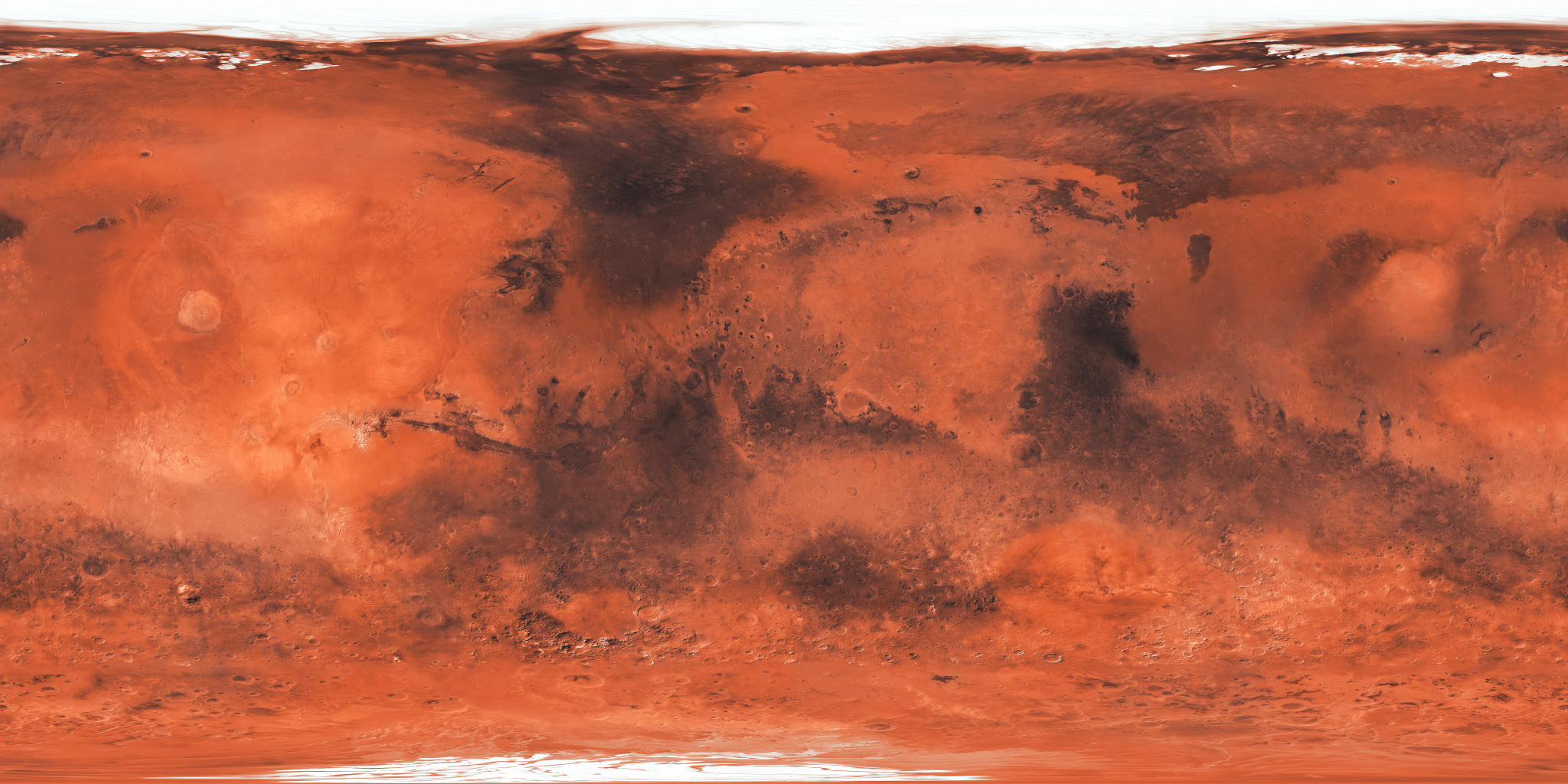
Rust-coloured deserts, the tallest volcano in the Solar System and ancient, long-dry riverbeds: Mars tells the story of a world that had abundant water billions of years ago — and that today is the most concrete destination for humanity's next great adventure.
- Diameter
- 6,792 km
- Distance from Sun
- 227.9 M km
- Orbital period
- 687 days
- Day length
- 24h 37m
- Moons
- 2
- Average temp.
- -63 °C
A world of records
Mars is half the size of Earth yet hosts giants: the volcano Olympus Mons rises 21.9 km — nearly three times Everest — and the Valles Marineris canyon system stretches 4,000 km, the distance from Rome to the Arctic Circle. Its red colour comes from iron oxide — common rust — coating its rocks and sands.
The Martian atmosphere, 95% CO₂, is extremely thin: surface pressure is less than 1% of Earth's. Too little to hold heat — the average is -63 °C — but enough to whip up dust storms that sometimes engulf the entire planet for weeks.
The lost water
The evidence is everywhere: river-carved valleys, fossil deltas, minerals that only form in the presence of water. Three to four billion years ago Mars had lakes, rivers and perhaps an ocean in its northern hemisphere. Then the planet lost its magnetic field, the solar wind stripped the atmosphere, and surface water disappeared.
Not all the water was lost: enormous quantities of ice survive in the polar caps and underground. It is a precious resource for future human missions — and it is precisely in those ancient watery environments that rovers are now searching for traces of past microbial life.
Exploration and moons
No planet has been studied as much as Mars: from the Viking landers of the 1970s to the rovers Spirit, Opportunity and Curiosity, up to Perseverance, which is collecting samples destined to return to Earth, and the small helicopter Ingenuity, the first aircraft to fly on another planet.
Two tiny, irregular moons orbit the planet, Phobos and Deimos, probably captured asteroids or debris from an ancient impact. Phobos orbits so close that it rises in the west twice per Martian day — and in 50 million years it is destined to break apart and form a ring.
The 2 moons of Mars
Mars has 2 confirmed natural satellites, every one of them officially named by the International Astronomical Union.
- Phobos
- Deimos
Frequently asked questions
Is there life on Mars?
No evidence of life, present or past, has been found so far. But Mars had liquid water and a milder climate billions of years ago, so microbial life could have existed: rovers like Perseverance are collecting samples precisely so Earth laboratories can search them for traces.
Why is Mars red?
The colour comes from iron oxide — the same rust that forms on Earth — abundant in Martian rocks and dust. Sandstorms lift these particles into the atmosphere, tinting even the planet's sky red.
How long does it take to get to Mars?
With current trajectories, 6 to 9 months: probes launch when Earth and Mars are favourably aligned, a window that opens every 26 months. A human round-trip mission would take two to three years in total.
Watch the whole Solar System in motion
Real orbits, moons and speeds rebuilt from NASA/JPL data, right in your browser. Free, nothing to install.
Launch the 3D simulation